


Meat Delivery vs. Grocery Store: Is It Worth It in 2026?
Let’s be real: the grocery store is a lie.
You walk in, the lights are bright, the floor is waxed, and there’s a wall of red meat wrapped in plastic. It looks fine. It looks "convenient." But as a butcher who has spent years looking at the underside of this industry, I’m here to tell you that what you see in that display case is often the "fast fashion" of the food world.
It’s 2026. You can have a self-driving car and a fridge that orders milk for you, yet most people are still buying steaks that have spent three days sitting in a lukewarm display case (those open air cases? They are 40 degrees Fahrenheit at best... far away from the 29 that is ideal for beef). . If you're asking is meat delivery worth it, you’re actually asking if your dinner deserves to be better than "fine."
At Meat N' Bone, we don't do "fine." We do premium. Let’s pull back the curtain on why the grocery store is failing you and why online meat delivery is the only way to cook in 2026.
101: The Grading Game (And Why You’re Getting Played)
In the US, we use USDA grading: Select, Choice, and Prime. Most grocery stores live in the "Choice" lane. Occasionally, they’ll brag about having "Prime" beef, some of them venture into Wagyu and Grass Fed. There are a few that do a good job, but that's the few. The bulk of them? They suck.
Here is the truth: USDA Prime is a spectrum. The USDA looks at the marbling (that beautiful intramuscular fat) between the 12th and 13th rib. Large-scale grocery chains often buy the absolute bottom tier of the Prime grade, the stuff that just barely made the cut. It’s "Prime" on paper, but "Choice" in your mouth.
At Meat N' Bone, we source what we call "High-End Prime" or G1 Certified. We aren't looking for the bare minimum; we are looking for the outliers. When you buy Wagyu beef or a USDA Prime Ribeye from us, you aren't getting the leftovers of a mass-production facility. You’re getting the top 1-2% of all beef produced in this country.
The Reality Check: Grocery store "Prime" is often mass-produced, wet-aged in a bag for a few days, and tossed onto a shelf. Our steaks are handled by human beings who know how to trim a fat cap so you aren't paying for waste.

201: The Cold Chain (Dry Ice vs. The "Oops" Case)
Have you ever looked at the thermometer inside a grocery store meat case? If you haven't, don't start now, it’ll ruin your appetite. Those open-top cases are notoriously bad at maintaining a consistent temperature. Every time a customer leans in or the store’s AC kicks off, the surface temperature of that meat fluctuates.
Fluctuation is the enemy of freshness. It breeds bacteria and ruins texture.
Now, let’s talk about online meat delivery done right. We utilize a strict "Cold Chain" process.
-
Flash Freezing: We vacuum-seal our proteins at the peak of freshness and flash-freeze them. This locks the cell structure in place so that when you thaw it, the juices stay inside the meat, not on your cutting board.
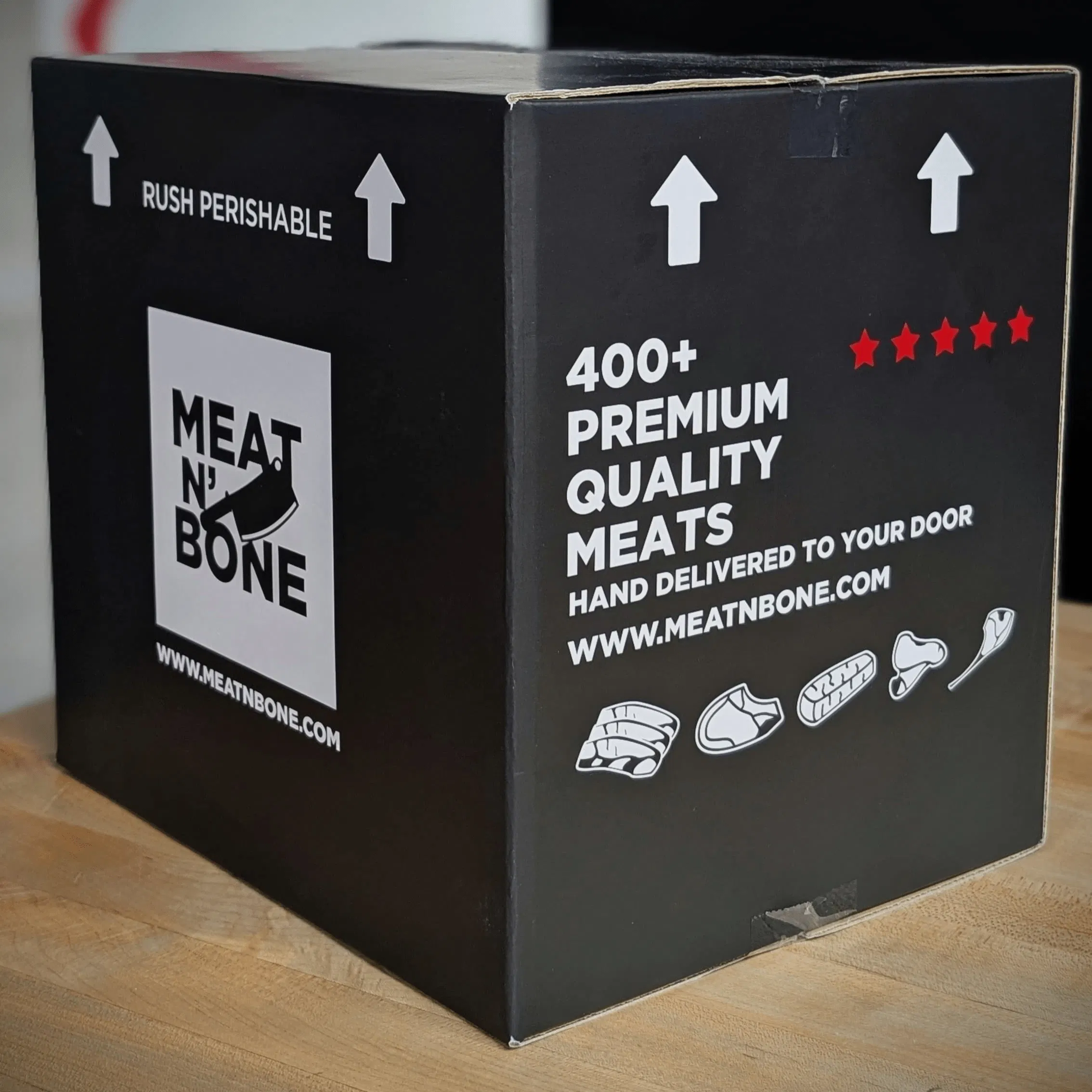
- The Shipping Tech: We don’t just throw it in a box. We use high-density insulated liners and enough dry ice to keep your order at a steady sub-zero temperature until it hits your porch.
When you open a Meat N' Bone box, you’ll see the vapor from the dry ice. That’s the smell of a steak that hasn't seen a degree of warmth since it left the butcher’s table.

301: Transparency and The Boutique Approach
The biggest problem with the grocery store in 2026 is the lack of a "paper trail." When you buy a pack of ground beef at a mega-supermarket, that meat could have come from dozens of different cows across three different countries. It’s processed in a facility that cares about volume, not value.
Is meat delivery worth it? It is when you know the name of the farm.
We take a boutique approach. We work with specialized farms that focus on heritage breeds, like our Iberico Pork or our pasture-raised poultry. We know how the animals were treated, what they were fed, and how they were slaughtered.
When you shop at a boutique online butcher, you aren't just a number in a spreadsheet. You’re a curator of your own kitchen. You can find cuts that simply don't exist in a grocery store, things like Picanha, Tomahawks, or authentic A5 Japanese Wagyu.
Convenience vs. Quality: The 2026 Trade-Off
People say the grocery store is more convenient. Is it, though?
-
Grocery Store: Drive to the store, fight for a parking spot, walk the aisles, wait in line, and settle for whatever "Choice" ribeye is left on the shelf. Total time: 60-90 minutes. Result: Average dinner.
- Meat N' Bone: Open your phone, select exactly which cuts you want (and how many ounces you need), and have it show up at your door in a branded, insulated box. Total time: 5 minutes. Result: Steakhouse-quality dinner at home.
In 2026, convenience isn't about "being nearby." Convenience is about not having to think about quality because you trust the source.
Let's Talk Money: The Price of "Cheap" Meat
The common argument against online meat delivery is the price. Yes, a Prime Filet from Meat N' Bone costs more per pound than a Choice Filet from a discount supermarket.
But let’s look at the math:
-
The Trim: Grocery stores often leave heavy fat caps and silver skin on the meat because they sell by weight. You’re paying $15/lb for 4 ounces of fat you’re going to throw away. We trim our steaks to "Steakhouse Standard." You pay for what you eat.
-
Water Weight: Mass-market meat is often injected with saline (brine) to keep it "moist" on the shelf. When you cook it, that water evaporates, the meat shrinks, and you end up steaming your steak instead of searing it. Our meat is dry-aged or properly handled, meaning you get 100% meat.
- The "Eating Out" Factor: The average cost of a high-end steakhouse dinner for two in 2026 is easily north of $200. You can buy the exact same (or better) quality cuts from us for $80 and cook them perfectly at home.
When you look at it that way, a premium online butcher actually saves you money while upgrading your lifestyle.
The Verdict
Is meat delivery worth it in 2026?
If you are someone who thinks a steak is just a "source of protein," then stick to the grocery store. But if you believe that a meal is an experience: if you want to taste the difference between corn-fed beef and grass-fed finishing, or if you want the buttery melt-of-the-tongue texture of Miyazaki Wagyu: then there is no comparison.
The grocery store is built for the masses. Meat N' Bone is built for the obsessed.
We aren't just a delivery service; we are your personal butcher. We’ve done the sourcing, the aging, and the hand-cutting so you can just focus on the grill.
Ready to stop settling? Skip the supermarket line and experience what real quality tastes like.
PS: This doesn't only apply to Steak... its the same for pork, poultry, seafood.
👉 Browse our Curated Collections 👉 Join the Meat Club for Exclusive Perks

#PremiumButcher #OnlineMeatDelivery #USDAPrime #WagyuBeef #MeatNBone #SteakLover #GrillMaster #FoodTransparency
← Older Post Newer Post →